

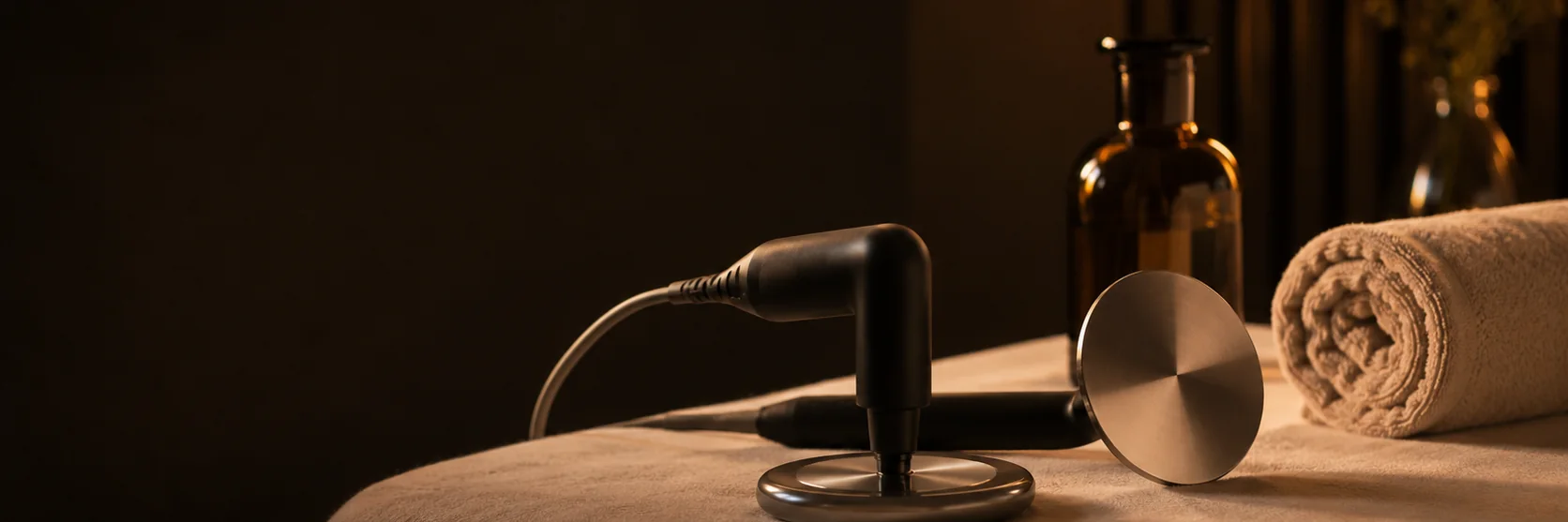
Facial radiofrequency: what it really does and how it differs from the home kind
Home devices have left a lot of people arriving with their suspicions. They're neither a con nor the same thing: the difference is in the power, in the temperature control and in who looks at your skin before the machine is switched on.
What radiofrequency is and what happens to your skin
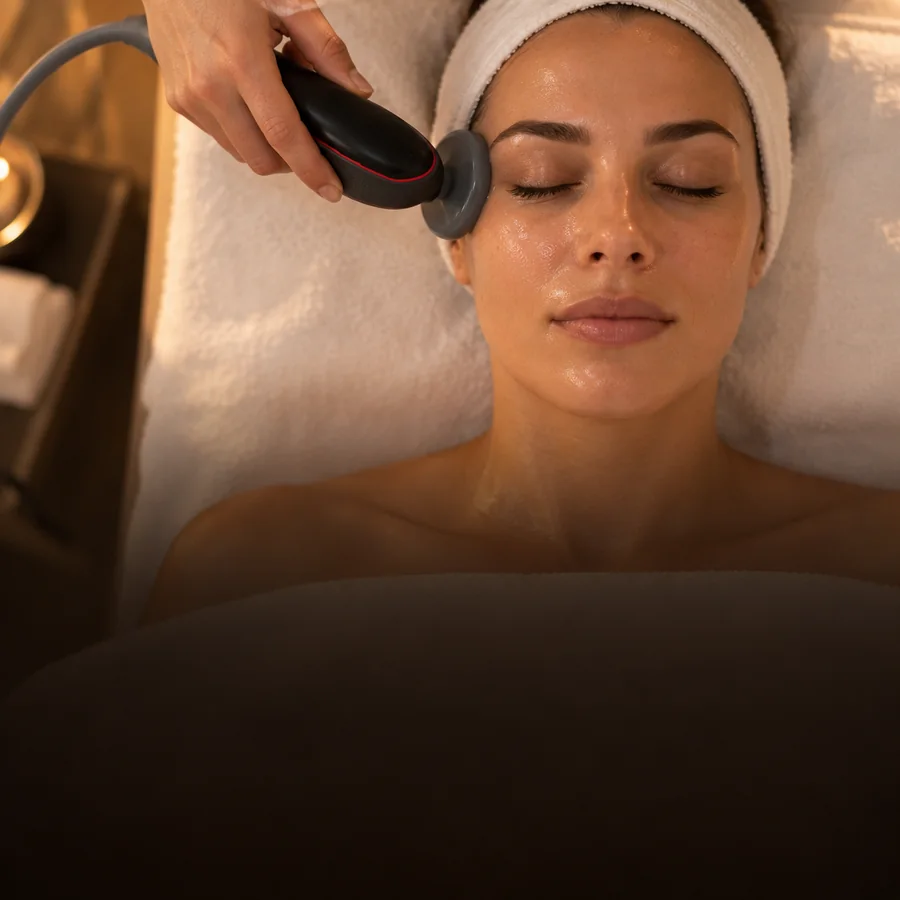
It doesn't cut, it doesn't prick and it doesn't burn on the outside. It's a high-frequency current —ours works at 448 kHz— that passes through the tissue and heats it from within. The skin on the surface barely feels more than a pleasant warmth, while underneath it reaches 39 or 41 degrees.
At that temperature two different things happen. The first is immediate: the collagen you already have contracts, which is why when you get up from the couch your face looks tighter and with better colour. The second takes time: the heat wakes up the cells that make new collagen, and that collagen starts to show at four to eight weeks.
It's worth not confusing the two. The same-day effect is real but it fades in a few days; the one that stays is the other, and that one comes with the whole course, not with a single session before a wedding.
What it really does, and what it won't do
What it does well: improve the texture and radiance, soften fine lines, restore firmness and redefine the jawline, and help with bags and dark circles through the drainage work. In the body version, on top of that, the deep heat leaves tense muscles much looser and a sense of rest that's welcome.
What it doesn't do: it doesn't replace a facelift. Advanced sagging, an established double chin or deep wrinkles can't be fixed with heat, they're disguised a little. If someone shows you a spectacular before and after and doesn't tell you what else was involved, be wary.
We'd rather you came knowing this. A client who expects a changed face leaves disappointed even if the treatment worked; one who expects firmer skin and a better-looking face leaves happy with the same result.
The home device isn't a scam. It's another thing
Let's be clear from the start: home radiofrequency devices do something. They heat the surface layer, the skin looks better for a while and, if they force you to spend ten minutes in front of the mirror with a decent cream, you've already gained something. For maintenance between courses they're not bad.
But they're not comparable, and not because of brand or posturing. There are three specific differences:
- The power. A home device is limited on purpose so you can't hurt yourself without supervision. That means the energy stays on top. And new collagen isn't made by the surface: it's made by the deep dermis, which is exactly where that device doesn't reach.
- The temperature control. In the studio the heat window is measured and held for as many minutes as needed, area by area. At home there's no way to know how many degrees your skin is on the inside: either you fall short, which is the usual thing, or you overdo it.
- The prior assessment. This is the big one. Nobody looks at your skin before switching on the home device. Here, half the consultation is deciding whether your issue is a lack of firmness, dehydration or a mark, and how many sessions you need. Sometimes the conclusion is that radiofrequency isn't the first thing you need.
If you've got this far after reading a comparison of home devices, you already know where this is going: what's questioned isn't that radiofrequency works, it's that a device designed to be used without supervision reaches where the advert promises.
How many sessions you need and how often
A facial session lasts an hour. The usual thing is a course of six to ten sessions, starting with one a week and spacing them out afterwards. When the skin reaches where we wanted, you move on to maintenance: one every three or four weeks, depending on your age and starting condition.
The number isn't decided on the website or over the phone. It comes from looking at your skin, which is what we do at the first appointment.
When it can't be done
The list is short but serious, and there's one that allows no exceptions: a pacemaker or any implanted electronic device, no. Not during pregnancy either, nor with an active cancer or one under treatment, nor with thrombosis or clotting problems.
With other things it has to be discussed beforehand: epilepsy, altered sensitivity to heat in the area —a diabetic neuropathy, for example—, metal implants where we're going to work, a copper IUD if the treatment is on the abdomen, or an infection or skin flare-up in progress. And if you've had hyaluronic acid or toxin recently, we leave a couple of weeks.
None of this is asked for the sake of it. It's asked because we're putting heat inside a body, and there are bodies that it doesn't suit.
Other guides
 Wellbeing · 22 September 2026
Relaxing or deep-tissue massage: how they differ and which to ask for
Wellbeing · 22 September 2026
Relaxing or deep-tissue massage: how they differ and which to ask for
 Beauty · 22 September 2026
Micropigmentation of brows and lips: you can have both done, but not at the same time
Beauty · 22 September 2026
Micropigmentation of brows and lips: you can have both done, but not at the same time
 Hair · 15 September 2026
Keratin on your hair: what the salon one does that the bottle from the shop doesn't
Hair · 15 September 2026
Keratin on your hair: what the salon one does that the bottle from the shop doesn't