

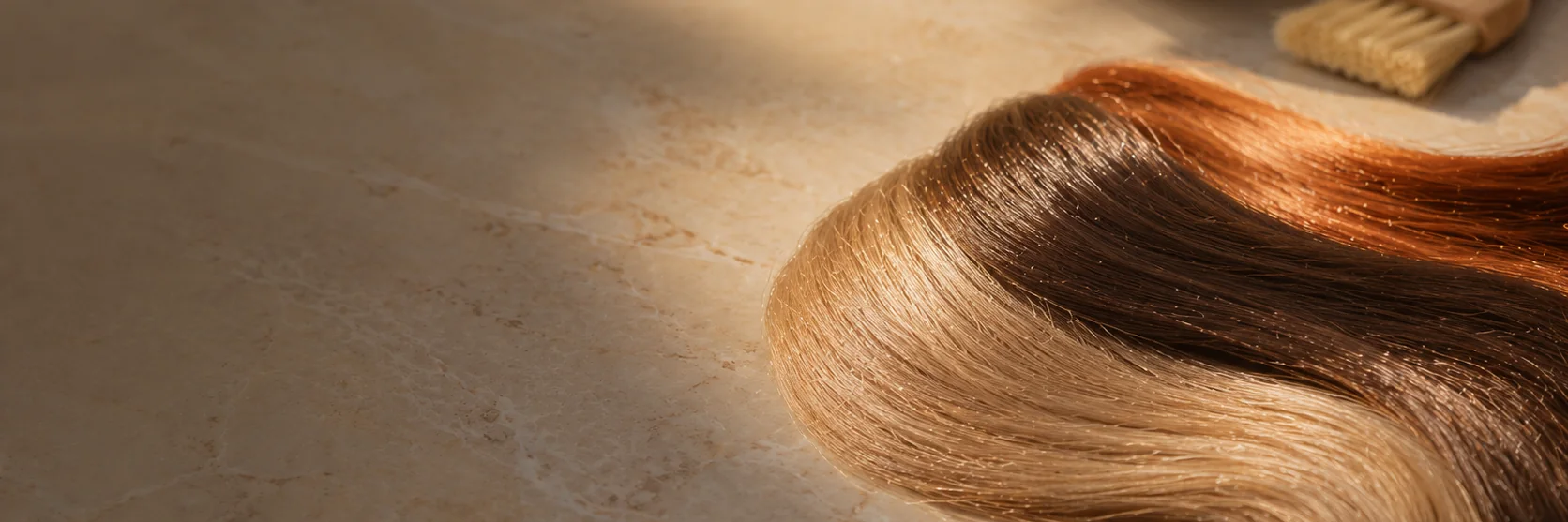
Ammonia-free dye: whether it covers grey just as well and how it differs from the usual one
The question we get most over the phone, and it comes from a confusion: “ammonia-free” doesn't mean what almost everyone thinks it means, and it certainly doesn't mean it'll last you less time.
Ammonia-free doesn't mean chemical-free
Let's start with what ammonia does, which is what almost nobody explains. It isn't “what colours”: it's what opens the hair's cuticle so the colour can get in and work on the inside. A doorman, not the guest.
In an ammonia-free colour that doorman still exists, it's just a different one: almost always ethanolamine. It does the same job more gently and, above all, doesn't evaporate. That's where the difference everyone notices comes from, which is the smell: ammonia is a gas and it stings your eyes; ethanolamine stays in the cream and barely smells at all.
So the line “I do mine ammonia-free because it has no chemicals” doesn't hold up. It does. What changes is how rough the doorman is, and that does show on a sensitive scalp and on hair that's already damaged.
The real question: will it cover my grey hair?
Yes, if it's a permanent colour. And here's the confusion that trips up half the people who call us: “ammonia-free” and “permanent” aren't opposites. One tells you what opens the cuticle; the other, whether the colour has developer and stays inside.
There are permanent ammonia-free colours that cover a hundred per cent of grey hair, and those are the ones we work with. And there are ammonia-free colours that don't cover, because they're tone-on-tone. The supermarket box that left your grey hair showing again after three weeks was probably one of the latter, and it wasn't the fault of the ammonia it didn't contain.
What really matters is what your grey hair is like. A grey hair is a hair that's stopped making melanin, and often it also comes with a more tightly closed cuticle and a thicker shaft: it takes colour less easily. That's why two people with the same percentage of grey hair don't have the same formula, and why some heads need a prior step before the colour.
The three types there are, and how long each one lasts
- Permanent. It has developer and stays inside the hair. It doesn't wash out: what happens is that your roots grow. It's the one that really covers grey hair, and the one that calls for coming back every three or four weeks if you have a lot and the contrast shows.
- Tone-on-tone or semi-permanent. It deposits colour without lifting and fades away over about twenty or thirty washes. It doesn't leave a marked root, which is the beauty of it. It adds shine, evens out and disguises a little grey hair; it doesn't cover it all.
- Temporary or colour rinse. It stays on the surface and lasts about a few washes. It's handy for freshening up the tone before a wedding or for trying something without committing.
If what you were after when you typed “colour that washes out” was not committing, your option is the second or the third. You just need to know that in return you won't cover the grey hair completely. It's a trade-off, not a trick.
What ammonia-free doesn't do: lift
This is its real limitation, and it's worth saying. To go lighter on natural hair —going blonde starting from brown— ammonia is more effective, and for big jumps what you need isn't a colour but a highlighting technique.
Ammonia-free covers, darkens, evens out and adds shine, which is ninety per cent of what people come in to have done. Properly lifting, no.
Why almost everything here is done ammonia-free
Because on most heads the other thing isn't needed. If the job is to cover grey hair and keep the tone, a permanent ammonia-free colour gets you the same with less stinging, less smell and a calmer scalp. It's what we suggest by default, and what nearly every colour we do uses.
It's not a flag we wave. If one day your hair calls for a colour with ammonia, we'll tell you and we'll do it: we suggest, we don't impose. But there has to be a reason, and that reason is set by your hair, not by the shop window.
What we look at before deciding
Before touching anything we look at how much grey hair you have and where —spread out isn't the same as concentrated at the front, which is the part that shows—; what condition the hair's in, because porous hair soaks up the colour and lets it go sooner; what you've got on from before, because colour built up over years doesn't react like virgin hair; and your skin tone, which is what decides whether a colour lights up your face or dulls it.
From that come the formula, the developer and the timing. That's why the same tone number gives different results on two heads, and why you don't choose from a photo.
Other guides
 Wellbeing · 22 September 2026
Relaxing or deep-tissue massage: how they differ and which to ask for
Wellbeing · 22 September 2026
Relaxing or deep-tissue massage: how they differ and which to ask for
 Beauty · 22 September 2026
Micropigmentation of brows and lips: you can have both done, but not at the same time
Beauty · 22 September 2026
Micropigmentation of brows and lips: you can have both done, but not at the same time
 Hair · 15 September 2026
Keratin on your hair: what the salon one does that the bottle from the shop doesn't
Hair · 15 September 2026
Keratin on your hair: what the salon one does that the bottle from the shop doesn't