

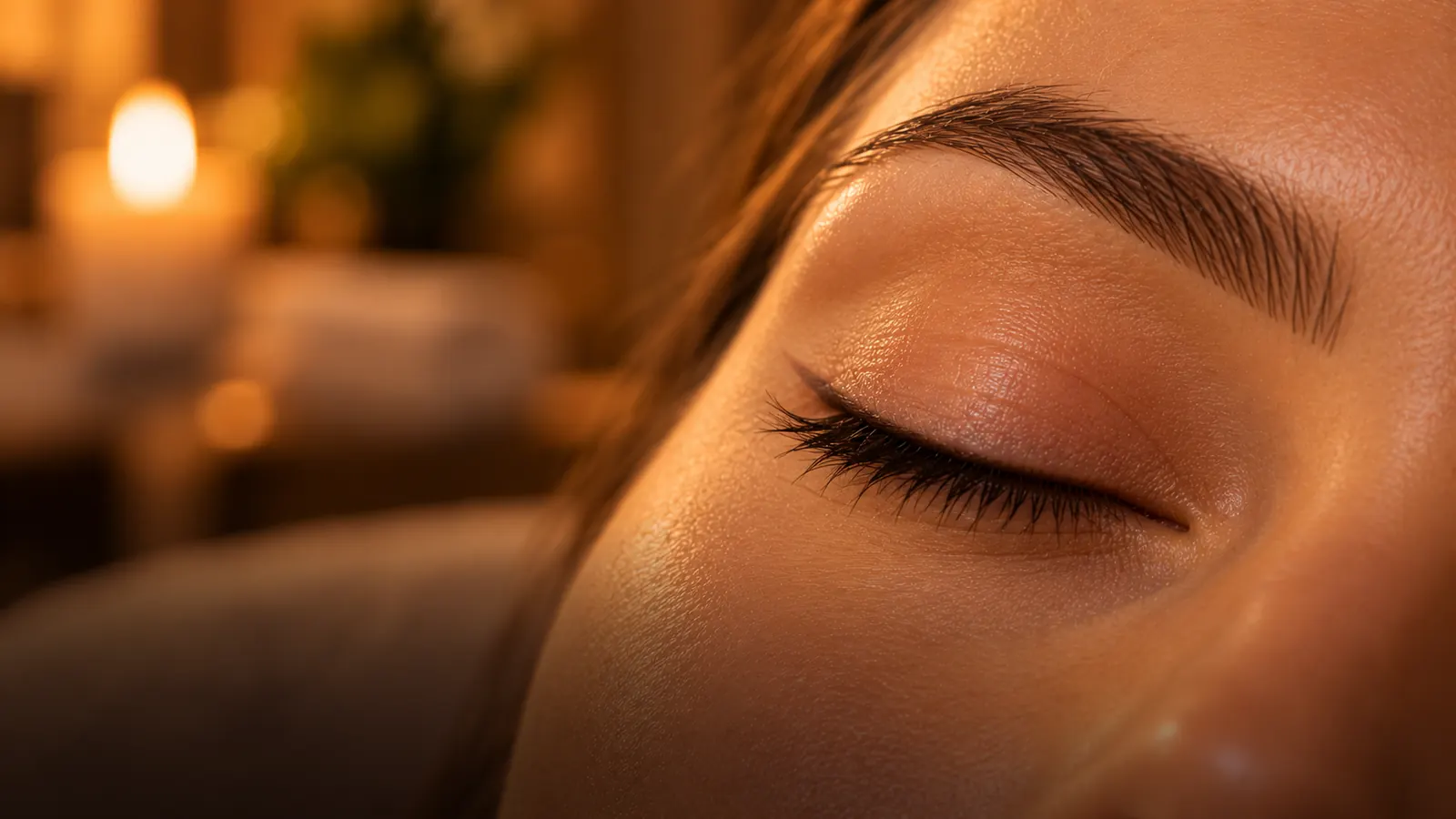
Eye micropigmentation: how long it lasts and which line to ask for
Of the three areas of the face that are micropigmented, it's the one that lasts longest. What almost nobody tells you is that “the eyes” are three different jobs, and that the good one is usually finer than what you come in asking for.
How long it lasts: longer than the brow and the lip
It normally lasts two or three years before you need a touch-up, and some eyelids go beyond that with no problem. Of the three areas it's the longest-lasting. A brow stays one to three years and a lip, one or two.
There's a reason for it. The eyelid has almost no oil to push the pigment outwards, it doesn't get rubbed with the towel like the forehead and nobody puts acids or retinol there, and on top of that the line is usually black or very dark brown, which is where it takes longest to notice the colour has faded.
What shortens it is the usual: sun without sunglasses, rubbing your make-up off every night and young skin, which renews itself sooner.
And one thing worth knowing from the start. It fades, but on the eyelid it rarely goes away completely.
“The eyes” are three different things
When someone calls and asks for “the eyes”, they could mean any of these three. And they're nothing alike.
- Between the lashes. The gaps left between one lash and the next are filled in, at the root, without drawing any line. Head on you don't see a line: you see more lashes. It's the most discreet, and the one that suits people who never wear make-up best.
- Eyeliner. A line above the lashes, fine or more defined, which can end in a small flick. It's the one that replaces the pencil every morning, and the one most asked for.
- The lower line. It's done rarely and almost always very soft, blurred. Done strongly it hardens the look, and it's the one that blurs most over the years.
They can be combined (the most common is between the lashes with a fine eyeliner on top), but you don't need to come with it decided. Which one suits you depends on your eyelid, on whether it droops a little at the outer corner, on whether the crease covers the line when you open your eye, or on how close together or far apart your eyes are, and all that is seen with the pencil in hand and your face in front of us, not in an Instagram photo.
Why we're going to suggest it finer than you ask for
It's the most important thing in this guide. And what gets debated most on the couch.
A line on the eyelid can be made thicker at the touch-up with no problem. Making it thinner, no. Removing pigment so close to the eye is about as delicate as it gets, because the laser there needs a metal shield on the eye, several sessions and someone with a very steady hand, and even then it doesn't always come out clean. So the first time we work short. If after a month it feels like too little, we build it up.
The same goes for the flick, and here time comes in. The flick that lifts your look today rests on the outer corner of the eyelid, which is exactly the skin that droops most over the years; long at thirty-five, it could be pointing downwards at fifty. That's why it's left shorter than the one you do with a pencil. The pencil one you take off at night.
And there's one spot best not touched even if you ask for it: the waterline, the moist part of the rim, inside the lashes. That's where the glands are that supply the oil for your tears, and the ophthalmology studies that have looked at tattooed eyelids find more dry eye the closer the pigment goes to the rim. Outside, yes. Inside, no.
What you need to tell us beforehand, and that doesn't matter for the brow
Everything we ask about for a brow applies here too: pregnancy and breastfeeding, isotretinoin, anticoagulants, poorly controlled diabetes, a tendency to keloids, allergies to pigments. But the eye brings its own list:
- Conjunctivitis, a stye or blepharitis. We don't work on an inflamed eyelid. We wait until it's completely healed.
- Eye or eyelid surgery. Cataracts, laser for short-sightedness, blepharoplasty: nothing until your ophthalmologist signs you off.
- Dry eye, or daily eye drops. Especially the ones for eye pressure, because some contain the same active ingredient as lash serums. This needs to be talked through before booking the appointment.
- Lash growth serums. They leave the area more sensitive and more prone to bleeding, and the pigment takes less well. You stop them well in advance; how long, we'll tell you at the consultation.
- Extensions or a lift. Extensions come off beforehand. And neither one until the eyelid has healed.
- Contact lenses. They're not a problem, but come to the appointment in your glasses.
What you'll see in the mirror
With the eye everything goes faster than with the brow. The first day, mind you, is more striking:
- The first day and the next. Swollen eyelids, as if you'd been crying, and a line thicker and blacker than the one you chose. In the morning, when you wake up, is when it shows most. It goes down on its own.
- From the third to the seventh day. It peels in very fine flakes, quite a bit smaller than the brow's. It itches a little. Don't scratch or pick it: each flake takes a little piece of the line with it.
- Second and third week. The line looks lighter, and maybe with a weaker patch here and there. That's normal. The eyelid moves and waters, and it never takes evenly from one end to the other.
- From the fourth to the sixth week. It's now the colour that stays, and it's time for the touch-up: it fills in those patches and, if it felt like too little, builds up the intensity.
Count on that touch-up when you plan ahead. Almost everyone needs it, and on the eyelid more than anywhere else.
The first few days
The exact aftercare is given to you by whoever does it, on the day of your appointment. There are a few that are the same everywhere.
No mascara, pencil or eyeshadow until it's finished peeling. And when you go back to mascara, make it a new one, because the old one has been going in and out of the tube for months and it's not what you want next to skin that's just closed up.
Contact lenses out for a few days (we'll tell you how many). No swimming pool, no sauna, no sea while it heals, as the chlorine and salt eat away freshly applied pigment. And don't rub your eyes, which when they itch is the hardest part of all.
After that, sunglasses. Nothing more.
What almost nobody tells you: the MRI scan
Many pigments contain iron oxides. If one day you have an MRI scan, in some rare cases you feel warmth or a tingling in the area. It's no reason not to have it: just tell the technician before you go in.
Whose mornings it changes most
Anyone who draws their eyeliner on every day and is fed up with it, of course. But above all anyone who can't: you wear contact lenses and the pencil irritates your eyes, you're allergic to eye make-up, you no longer see well enough up close to draw the line, or you have a shaky hand. Or your eyelashes are pale or sparse and never show.
If that's your case, start with the lash-line one. It's the least risky, and if you want more later, you can even add a fine eyeliner on top.
Other guides
 Wellbeing · 22 September 2026
Relaxing or deep-tissue massage: how they differ and which to ask for
Wellbeing · 22 September 2026
Relaxing or deep-tissue massage: how they differ and which to ask for
 Beauty · 22 September 2026
Micropigmentation of brows and lips: you can have both done, but not at the same time
Beauty · 22 September 2026
Micropigmentation of brows and lips: you can have both done, but not at the same time
 Hair · 15 September 2026
Keratin on your hair: what the salon one does that the bottle from the shop doesn't
Hair · 15 September 2026
Keratin on your hair: what the salon one does that the bottle from the shop doesn't