

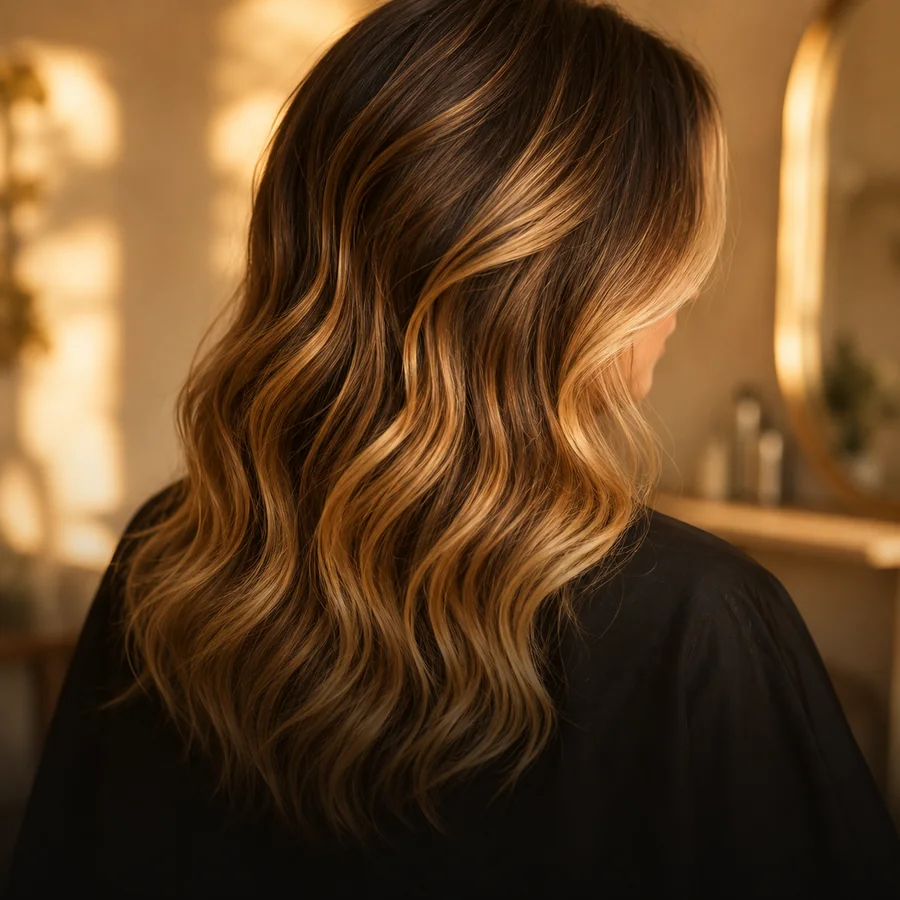
Highlights and colour at home: what works and what only gets fixed in the salon
There are things from a supermarket kit that come out perfectly, and there are others that then mean three trips to the salon. The line isn't where people think it is.
What a home kit does perfectly
I'll start here because otherwise it looks like I'm only talking my own corner. There are colour jobs that get done in a kitchen and turn out well, and saying otherwise would be lying to you.
Touching up the root with your own tone, when you wear a brown or a dark colour similar to your own, turns out well. A tone-on-tone to add shine or freshen up, too: it doesn't lighten, so the margin for disaster is small. And a colour rinse, the kind that washes out, the same. All of that has one thing in common: there's no bleaching involved.
That's where the line is. Not between home and salon, but between putting colour in and taking it out. Taking it out is what has no going back.
Foil highlights: the problem isn't the foil
Anyone can buy aluminium foil and the kit comes with clear instructions. What it doesn't come with is what really decides the result.
First, what you can't see. The nape and the sides at the back are done blind, and that's where you get the over-lightened bits and the gaps that don't take. With two mirrors you can manage something; you manage so-so.
The second thing, and this surprises everyone: the roots lighten faster than the rest. The heat from your scalp speeds up the bleaching of the first three or four centimetres, so if you put the same product on for the same time all over your head, the roots will end up several shades ahead. It's the famous hot-roots effect, that pale band right up against the scalp, and in the salon we avoid it with different strengths and a set order of application, not with knack.
And the third thing, timing. On one head the first foils have had twenty minutes more than the last ones by the time it's rinsing time. On your own and in a hurry, that gap turns into stripy hair in two different shades.
Bleaching over dyed hair is a different game
This is the one that causes the most upset, and people search for it because a lot of them don't know that dye doesn't come out with dye. If you've got colour on and you put a lighter shade over the top, you don't lighten: you go darker or stay the same. To really lift you have to pull the pigment out, and that means bleach.
Bleach on hair that's had years of colour doesn't work the same all the way down. The virgin roots lift clean, the mid-lengths with two dyes on them stay orange, and the ends, which are the most porous, over-process and break. All at once, on the same head, in the same hour.
There are also two cases where you simply have to stop. One, henna and dyes with metallic salts: they react with the bleach, heat up and can even burn the hair inside the foil. That's why we always ask what you've put on before, even if it was a year ago, and why we do a strand test when there's any doubt. And two, hair that's already damaged: on hair that stretches and doesn't spring back, bleaching means cutting it all off in three months.
The three fixes that come through our door the most
- Stripes and pale roots. The hot roots from before, or highlights from three different sessions that no longer match each other. It's corrected by evening out and toning, and sometimes with root work in the opposite direction.
- Patchy orange. The warm tone that shows through when hair is lifted too little or badly. You don't cover it with an ash dye from home —that gives a grey-green that's worse—: you neutralise it at just the right point.
- Lilac or grey patches. Purple shampoo on very porous hair, left on too long. It's the most rewarding fix of the three, but it comes in far more than it should.
And one request: if something has gone wrong, don't attack it again the same day. Almost everything that arrives beyond repair didn't arrive like that the first time, it arrived like that on the third attempt to fix it.
Why a fix can't be done in one afternoon
When something goes wrong, what comes next is almost never “run the product through again”. You have to see how many shades need moving, what state the hair is in and how much it can take, and often it's spread over several sessions weeks apart, precisely so as not to finish off what's left.
So, if you're toying with the idea of doing it at home, what will save you the most is asking first. Tell us what you've got on and what you want to get to, and we'll tell you whether you can do it on your own or whether it's one of those things that later brings three visits.
If you're going to do it anyway
Fine, but do it with a safety net. Try it first on a strand underneath, where it doesn't show. Never put bleach on hair that's already been bleached, even if it came out darker than you wanted. Go under the time on the box and check the hair every five minutes, because every head goes at its own pace.
And if you're going to come in afterwards, don't wash it forty times before the appointment to hide it. Come as you are and tell me exactly what you put on and when, brand included. I'm not asking to tell you off: I'm asking because what you've got in there decides whether it can be touched today or whether we have to wait.
Other guides
 Wellbeing · 22 September 2026
Relaxing or deep-tissue massage: how they differ and which to ask for
Wellbeing · 22 September 2026
Relaxing or deep-tissue massage: how they differ and which to ask for
 Beauty · 22 September 2026
Micropigmentation of brows and lips: you can have both done, but not at the same time
Beauty · 22 September 2026
Micropigmentation of brows and lips: you can have both done, but not at the same time
 Hair · 15 September 2026
Keratin on your hair: what the salon one does that the bottle from the shop doesn't
Hair · 15 September 2026
Keratin on your hair: what the salon one does that the bottle from the shop doesn't