

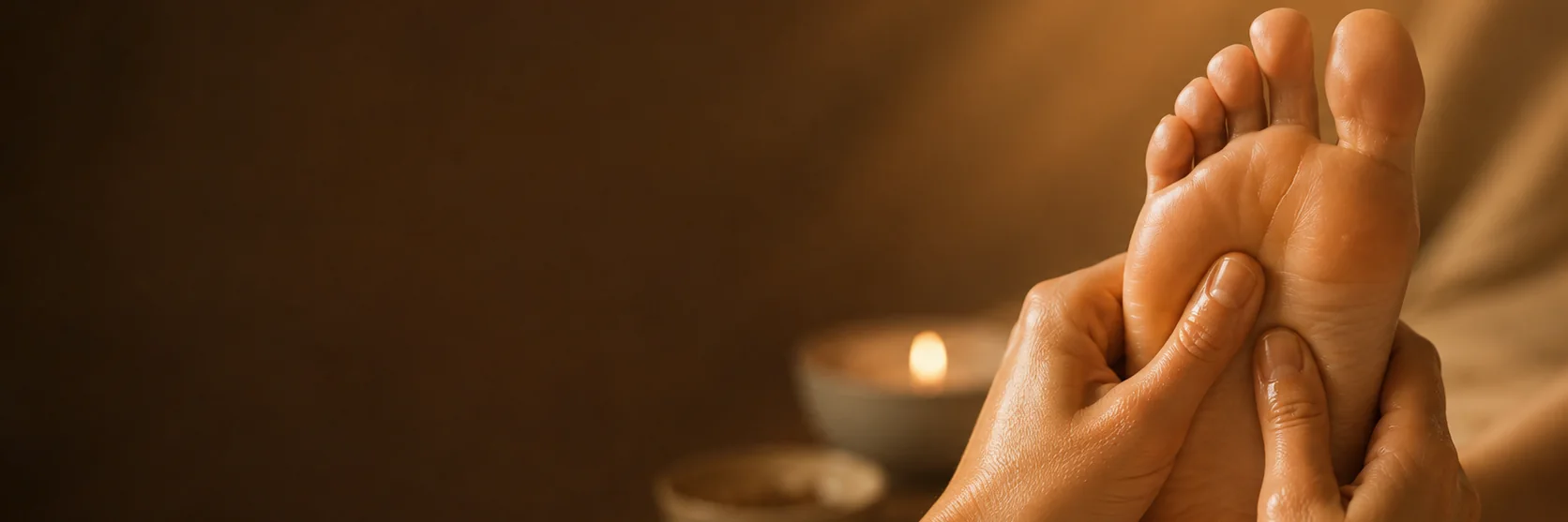
Foot reflexology: what you really feel in a session, and what you don't
What exactly is done to the foot, what you'll feel when you get up from the couch and what the evidence says when you look at it closely. Including what it doesn't do, which is the part almost nobody tells.
What it is exactly, and what it isn't
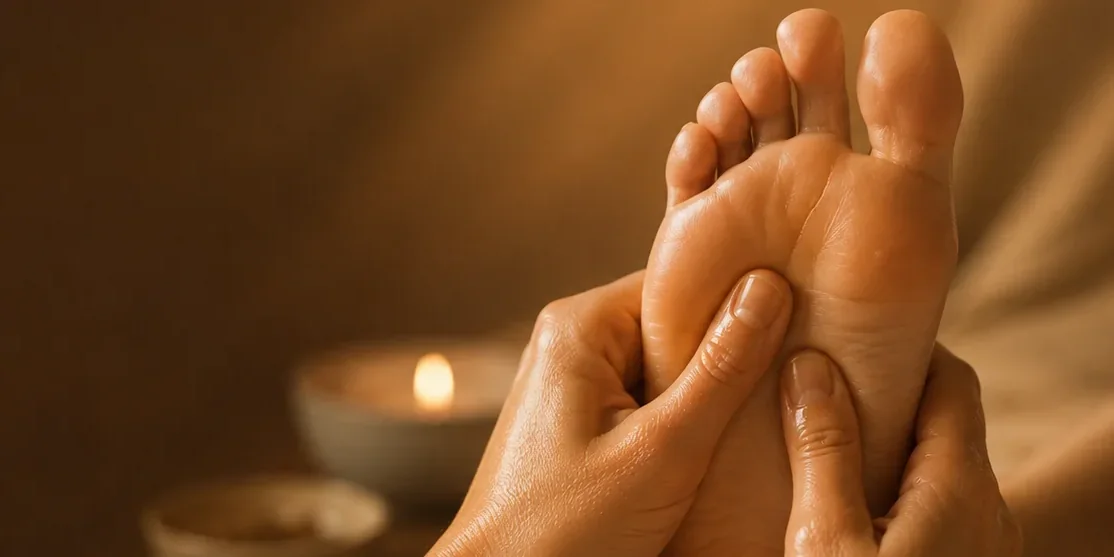
Firm, sustained pressure with the thumb, point by point, across the sole, the instep and the toes. It follows a map that divides the foot into zones, and goes over the whole thing in a fixed order, without skipping anything.
It's not the foot massage of a spa, which is rubbing with cream and feels lovely. Here you press, hold the pressure for a few seconds and move on to the next point. You feel it more.
And a practical thing almost nobody says: you don't have to undress. Shoes and socks off, and that's it. That's why it's one of the few treatments you can fit into a lunch hour.
What the evidence says, without embellishment
Here we're going to be more honest than suits us, because we think that in the long run it works out better.
The Ministry of Health published a report in 2022 reviewing all the serious studies there are on foot reflexology. Its conclusions, in short: it produces a small improvement in anxiety levels compared with a normal foot massage; for the rest of the things that have been measured —pain, fatigue, sleep quality, blood pressure, quality of life— no proven changes are observed; and it's a safe technique, with no significant adverse effects.
Translated into what matters to you: it's good for stopping and winding down. It doesn't cure, it doesn't treat illnesses and it doesn't replace anything your doctor has told you. If someone tells you that pressing a point on your foot fixes your liver, your thyroid or your fertility, leave the way you came in.
What is true is smaller and more boring to tell: half an hour lying down, no phone, no one talking to you and someone working your feet slowly. That has a value. It's just that that value is called rest.
What the half hour is like
You lie back on the couch, face up and covered, and the first thing is to look at your foot: what your skin's like, whether there's any hard skin, whether anything hurts when you put weight on it. Then it starts, almost always at the heel, and works up.
You'll find some points that bother you more than others. That's normal and it doesn't mean there's anything wrong with you: it means there's more tension there, or the skin's more sensitive. The pressure's eased off and it carries on; this isn't about gritting your teeth.
Usually you end up half asleep and floating, and your body feels a bit heavy for the rest of the afternoon. Some people get sleepy. Sleep.
Who it's a good idea for
- For anyone who's been sleeping badly for a while or whose mind is racing and can't switch off.
- For anyone who ends the day with heavy legs from being on their feet.
- For anyone who isn't comfortable with a body massage: you don't have to take your clothes off or let anyone touch your back.
- For anyone who wants to try something on the couch for the first time and finds booking a whole hour daunting.
When it's not the time
Not today: a fever or an infection under way, as your body's already busy enough; open wounds, fungal infections, plantar warts or active eczema on the foot; and a recent sprain or fracture in the foot or ankle.
Let's talk about it first: thrombosis, phlebitis or clotting problems —and this isn't a formula to cover ourselves, it's the one serious contraindication here—; anticoagulant treatment; diabetes with a delicate foot or loss of sensation; and pregnancy, especially in the first few months.
If any of those apply to you, there's no harm in asking over the phone before you come.
How often
There's no rule that works for everyone, partly because it isn't a medical treatment and there's nothing to “complete”. People use it in two ways.
As a one-off treat, on a day you can: perfect, and nothing more is needed. Or as a habit, once a week for a few weeks, which is what people who use it to sleep better tend to do. If that second way suits you, say so and we'll arrange it to fit into your week.
Other guides
 Wellbeing · 22 September 2026
Relaxing or deep-tissue massage: how they differ and which to ask for
Wellbeing · 22 September 2026
Relaxing or deep-tissue massage: how they differ and which to ask for
 Beauty · 22 September 2026
Micropigmentation of brows and lips: you can have both done, but not at the same time
Beauty · 22 September 2026
Micropigmentation of brows and lips: you can have both done, but not at the same time
 Hair · 15 September 2026
Keratin on your hair: what the salon one does that the bottle from the shop doesn't
Hair · 15 September 2026
Keratin on your hair: what the salon one does that the bottle from the shop doesn't