
Blonde highlights in brown or dark hair: what your base decides
Under brown hair there's always orange waiting. Your base decides which blonde can be achieved, how much lightening it takes to get there and how long the tone will last on you. That's why someone else's photo doesn't work as a recipe.
The first thing we look at is your roots, not the photo you bring
Almost everyone arrives with a photo on their phone, and it's good that you bring it: it tells us what you like. It doesn't tell us where that hair started from.
In hairdressing, bases are counted from 1, black, to 10, the lightest blonde. A dark brown is a 3, a medium brown a 4 and a light one a 5. If you're a 3 and the girl in the photo started from a dark blonde, a 6, you're three tones apart before putting in a single highlight.
That's why asking for “the same as my friend” doesn't give the same result.
The same product, the same exposure time and the same hand give a different colour on a different base. It's not the technique failing. You're starting from a different place.
Before-and-after photos, the same. The after is the day of the appointment, with the toner freshly done and the salon lighting; two months later it would be a different photo, and nobody posts that one.
Under brown hair there's orange
Lightening means drawing out pigment, and dark hair doesn't go from brown to blonde in one go. It releases colour in layers: first the red shows, then the orange, then the yellow and, at the end, that pale yellow on which a light blonde is built.
What shows at each moment is called the underlying pigment, and it depends on where you start. A light brown already starts at orange. A dark blonde, at a yellowish orange. And a dark brown has to pass through the red and the orange entirely, which is why on that base it shows so much when the lightening falls short, even by a single tone.
So yellow or orange highlights aren't always a mistake. Often they're a stop halfway there: it was lightened as far as it was lightened, and what you see is what was underneath.
Knowing that changes the conversation.
The toner corrects the tone, but it doesn't lighten
That underlying pigment is corrected with its opposite colour. Violet neutralises yellow. Blue neutralises orange. That's what a toner, or a colour gloss, does, and that's why it suits a yellowish highlight so well.
What it doesn't do is lighten. It adds colour. It doesn't remove it. If the highlight stopped at orange and you put a toner on top to make it beige or ash, it doesn't come out blonde. It dulls towards a light brown, and sometimes with a greyish or greenish tint that nobody wanted.
That's the difference behind almost every search for how to tone orange highlights. If the orange is a tint, it can be toned. If it's the point the highlight reached, no toner will fix it, because what's missing is lightening a little more, with the hair in a condition to take it, and that's a different job.
Mind you, the toner washes out. It happens to all blondes, whatever the base. We talk about how to make it last at home and how often to refresh it in the guide on how long highlights last.
Which blonde a dark base calls for
For a brown base there are no forbidden blondes. What changes is how much distance there is to each one, and the hair fibre feels it and you feel it in the upkeep.
Warm blondes, like honey, caramel or golden, stay two or three tones above your base and work with the underlying pigment that will show, not against it. They call for less bleach, the hair takes it better and, when the toner washes out, what comes back is warmth over a blonde that was already warm. You barely notice it.
Cool, very light blondes (beige, ash, platinum) force you to pass through all the orange to reach the pale yellow. From a dark brown that's a long way. It can be done, but it's more bleaching, more toning and more visits, and the roots show sooner because the contrast is greater.
Then there's your face.
The same blonde brightens or dulls depending on your skin tone and the colour of your eyes. That's looked at before choosing, not once it's already done.
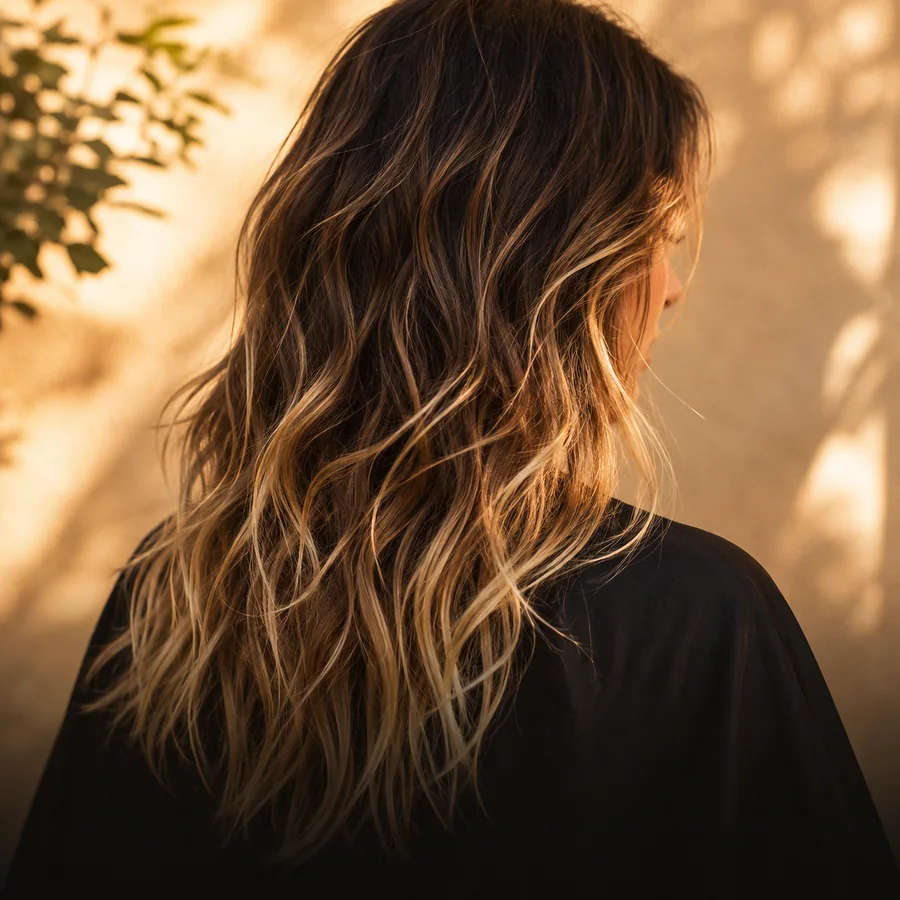
If you're unsure, start small. Very fine babylights give light without changing the colour. A balayage keeps the roots in your tone and blends towards the ends. And highlights only at the front, around the face, let you try the blonde where it shows most before going further.
A note on grey hair. On brown hair, blonde highlights hide it well. When the grey grows out it blends with the light, instead of marking a white line against the dark.
And without bleaching?
It's one of the most searched things. And on dark brown the short answer is that it won't give a blonde.
With dye you can lighten hair that isn't dyed a little. From a dark brown, that leaves a lighter, warmer brown, which can look lovely, but it's not the blonde highlight in the photo. To reach blonde you have to draw out pigment, and pigment is drawn out with bleach.
If your brown is dyed, even less so. One dye doesn't lighten another dye.
In one afternoon or several
From natural, healthy brown hair, highlights in a warm blonde, the kind that stay two or three tones above your base, are usually done in a single appointment and finished when you leave. A very light or ash blonde from that same base, especially if there's dye involved, is often spread over two or three sessions a few weeks apart.
It's not to drag it out. The hair takes a certain amount of bleaching at a time, and overdoing it in one afternoon is what leaves the ends broken, and then no toner or mask will bring them back and they end up falling to the scissors.
Before touching anything we'll ask what you've got on (a henna or a dye from a year ago count too), what state your ends are in and how often you can come. If there's any doubt, we test first on a strand underneath, where it doesn't show.
And if your base won't stretch to the blonde in the photo today, we'll tell you today.