

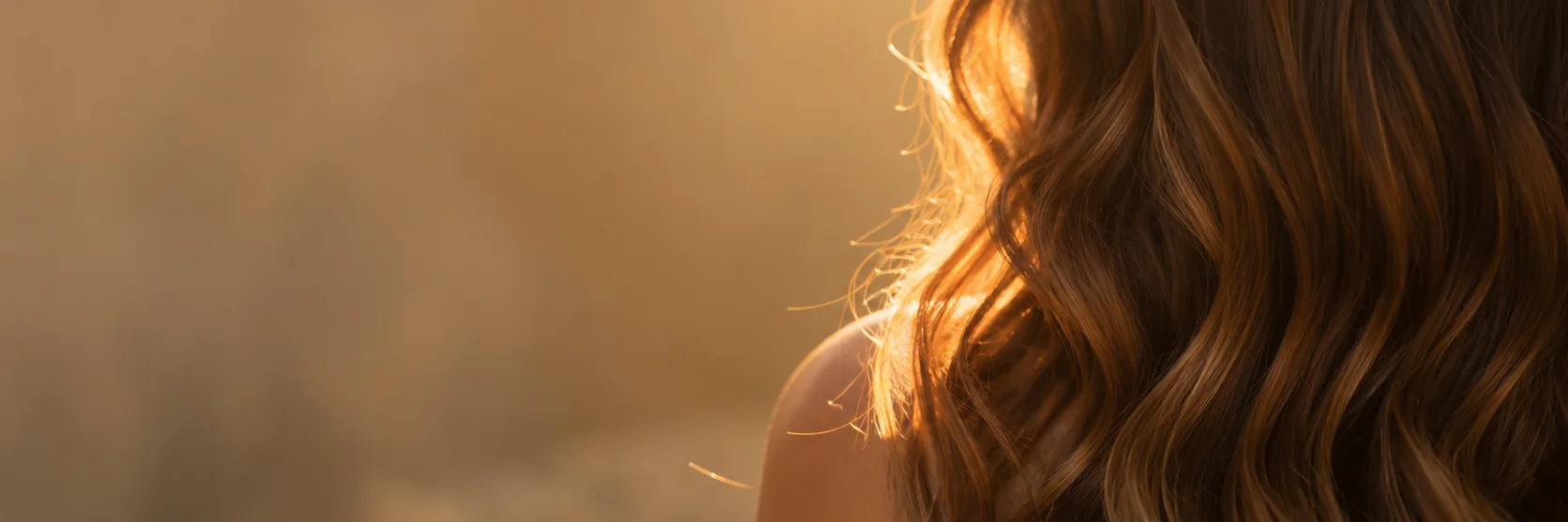
After a straightening treatment or keratin: the first few weeks decide how long it lasts
A straightening treatment that lasts six months and one that's gone in three weeks are often the same work. What changes is what happens in your shower over the following days.
Why the first few hours decide so much
A straightening treatment doesn't flatten the hair: it changes how the proteins sit inside the shaft and then it's sealed with heat. When you leave the salon, that seal is still settling, and the hair keeps the shape you give it during those hours.
That's where the one rule that's non-negotiable comes from: no ponytail, no clip, no hairband, no sunglasses on your head, and don't tuck it behind your ear. A crease made at that moment doesn't brush out; it stays for weeks.
How long without washing depends on the product we've used on you: some formulas ask for the classic 72 hours and others are sealed in 24. Don't go by what you've read in general, ask us on your way out and we'll tell you yours.
The shampoo is what ruins the most straightening treatments
If you take just one thing from this whole guide, make it this one. The enemy of a straightening treatment isn't water: it's salt. Look at the ingredients on the bottle and look for sodium chloride, which is salt. It's used as a thickener, it's in loads of supermarket shampoos and it opens up the work wash by wash.
Next comes the harsh sulphate, for the same reason as with coloured hair: it over-cleans. A shampoo without sulphates and without salt, whichever one, makes a straightening treatment last months longer. Here what you need to look at is the label, not the packaging.
And don't wash it every day. A straightening treatment washed daily has half the life of the same treatment washed three times a week. It's not a feeling: it's what we see when people come back.
Pool, sea and very hot water
The chlorine and the salt from the sea do what the salt in the shampoo does, but faster, and on top of that with the hair wet and open. If you swim often, the usual trick: wet your hair with fresh water before going in, because hair absorbs the first thing that reaches it, and rinse as soon as you come out.
Very hot shower water doesn't help either. Lukewarm, and a cold final rinse: it doesn't take you even a minute longer and you can see it in the shine.
Heat, the flat iron and a trap
The trap is this: because the hair ends up smooth and easy, people start ironing it because now it really does look perfect. And they put the same hair that's just had a heat treatment through two hundred degrees every day.
A well-done straightening treatment is for exactly the opposite: so that you don't need the flat iron. Hairdryer on medium heat, a hand's width away, and heat protectant whenever you use heat. If your hair needs the flat iron every day after a straightening treatment, there's something to check, and you tell me.
How long it lasts and what happens with the roots
What we do lasts between three and six months depending on the treatment, your hair type and —above all— what's above. It doesn't go all at once: it loosens gradually, the hair slowly goes back to its frizz, and the new hair that grows comes out as it naturally is, with its wave. That's not that anything went wrong, it's that this hair wasn't there when we did it.
The touch-up is done when the difference between the roots and the lengths starts to bother you. What you don't want is to chain treatments on the same lengths every three months: the lengths are already done, and putting product and the flat iron on them over and over is what ends up leaving them without body.
And if you also have colour, the order matters, and there's usually a need to leave a few days between one thing and the other. We plan it when we see you, that's what the first appointment is for.
The whole head of hair or just the front?
Ask about this, because hardly anyone knows it exists: if what bothers you is the frizz in the fringe and the front —which is what you see in the mirror and what lifts with humidity—, that area can be treated on its own, without going over the whole head of hair.
For a lot of people it sorts out exactly what was annoying them and leaves the rest of the hair untouched. If that's your case, say so when you book and we'll assess it.
When to call us without waiting
If after a few days your hair ends up matted or oddly greasy, if you notice an itchy scalp, or if after two weeks it's frizzed up as if you'd had nothing done. None of the three is normal, all three have an explanation, and it almost always gets fixed sooner if you tell me early.
Other guides
 Wellbeing · 22 September 2026
Relaxing or deep-tissue massage: how they differ and which to ask for
Wellbeing · 22 September 2026
Relaxing or deep-tissue massage: how they differ and which to ask for
 Beauty · 22 September 2026
Micropigmentation of brows and lips: you can have both done, but not at the same time
Beauty · 22 September 2026
Micropigmentation of brows and lips: you can have both done, but not at the same time
 Hair · 15 September 2026
Keratin on your hair: what the salon one does that the bottle from the shop doesn't
Hair · 15 September 2026
Keratin on your hair: what the salon one does that the bottle from the shop doesn't