

Diode laser hair removal: whether it hurts, how many sessions you need and who shouldn't have it done
The three questions we're always asked before we start, answered without beating around the bush: what you really notice, how many sessions you need and in which cases we'll tell you no.
First, because it's the most asked: does it hurt?
It's uncomfortable. I won't tell you that you don't feel it, because you do. But it's a short, very specific discomfort: a hot elastic band flicking against your skin, many times in a row. An upper lip is two minutes and that's it.
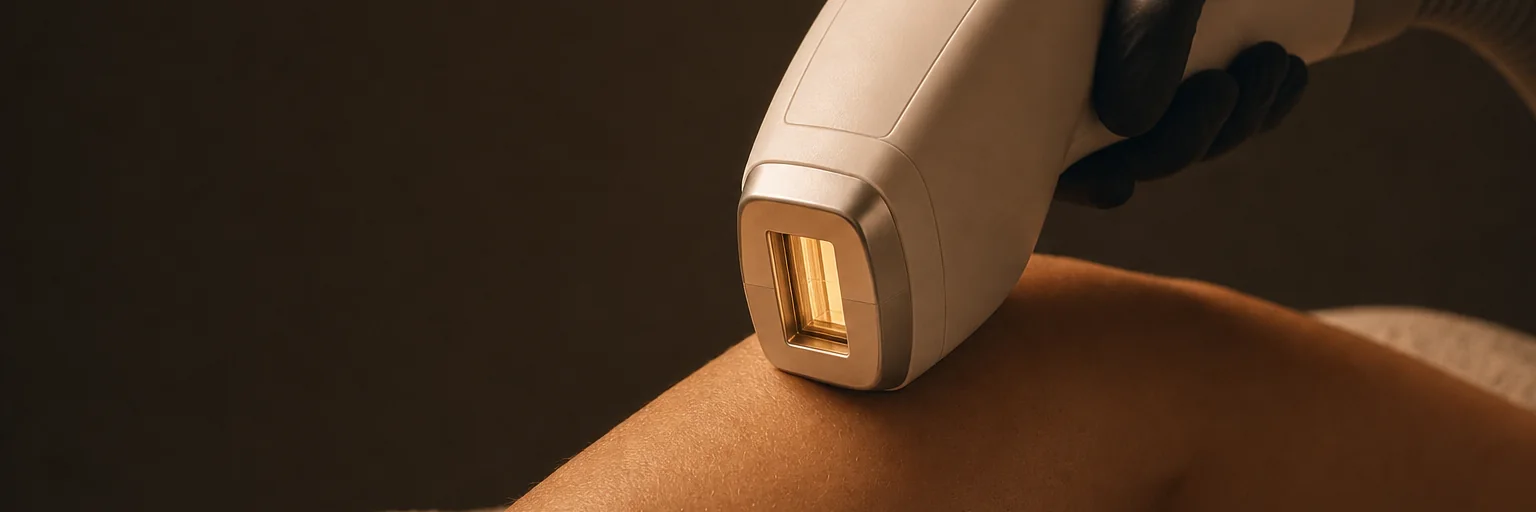
Diode laser is worked in a sweep, with the cold head resting and moving slowly, not in single shots like the machines from fifteen years ago. That changes the sensation quite a bit: there's no sharp blow, there's a heat that rises and falls. Where you feel it most is the bikini line, the upper lip and the inner thigh, which is where the skin is thin and the hair thick. On legs or arms most people are left waiting for something worse.
A heads-up that saves you a bad time: if you come during your period or the days before, you'll feel it more. It's not in your head, your pain threshold drops. If you can choose the day of the appointment, choose it.
Why your friend got on brilliantly and you might not
The laser doesn't see the hair: it sees its pigment. The melanin absorbs the light, heats up and that heat is what destroys the root. Everything else follows from that.
Dark, thick hair on fair skin is the textbook case: it works very well and you see results soon. Very fair blonde, red or grey hair has no pigment to heat, so the laser does nothing, and anyone who tells you otherwise is selling you sessions. In between there's fine, light hair, which does reduce, but less and more slowly.
And then there's the hormonal side, which explains half the disappointments. With a polycystic ovary, an unsettled thyroid or certain treatments, the hair on the face and neck can grow back even if the work is done well: there's a tap open behind it giving the order to make more. In those cases we're not talking about finishing, we're talking about keeping it in check, and it's worth knowing before you start and not at session six.
How many sessions you need and why you can't just come when it suits you
The usual is six to eight sessions per area, plus the odd top-up a year. The reason is that hair goes in cycles and the laser only destroys the hair that's growing at that moment, which is roughly a quarter of the total. The rest is dormant under the skin and doesn't even notice.
That's why the appointments are spaced out: six to eight weeks on the body, four to six on the face. It's not to drag the treatment out, it's that you have to wait for the next batch to come through. Bringing the appointment forward speeds nothing up; all it does is spend a session on hair that isn't there.
When it can't be done, and when you just have to wait
It's worth separating the two things, because almost everything people assume is impossible is really a “not right now”.
Not right now: skin that's been tanned recently or with fake tan —you need to let a few weeks pass—; wax or tweezers in the last month, because the laser needs the root in place; isotretinoin (the classic Roaccutane), which requires six months after you finish it; antibiotics and other medicines that make the skin photosensitive; an active cold sore if we're treating the lip; and any wound, burn or infection in the area. Pregnancy also waits, not because it's been shown to do harm, but because there's no reason to take the risk.
Not there, or not without a doctor seeing it first: we don't go over tattoos and moles, we work around them; skin lesions a dermatologist hasn't checked; a tendency to keloids; photosensitive epilepsy.
We ask about all this at the first appointment, and also what you're taking. It's not paperwork: most of the burns and marks you see around come from tanned skin or a medicine nobody asked about.
What depends on you between sessions
It's little and it's easy, but it's half the result. Shaving yes, wax and tweezers no: the razor cuts the hair and leaves the root, which is exactly what we're after; pulling it out leaves us with no target. Come shaved the day before or the same day, with clean skin and no creams.
No beach or direct sun in the days around the session, and sun protection on the area if it's uncovered. Afterwards it's normal for a little red dot to come up at each follicle, like goosebumps, which settles in a few hours. And if ten days later it looks to you like “hairs are coming through”, it's almost always the opposite: it's the dead hair that your body is pushing out.
Why we insist so much on the prior assessment
Because it's half the job. At that first appointment we look at your skin tone and the colour and thickness of your hair, what you've done so far, what you take and what you're hoping to achieve. From there come the three things that make this work: how many sessions it makes sense to plan, at what power and how often.
And sometimes what comes out of it is a “this isn't going to give you what you're after”. We'd rather tell you on the first day, before starting a whole course, than have you end up feeling the laser doesn't work.
Other guides
 Wellbeing · 22 September 2026
Relaxing or deep-tissue massage: how they differ and which to ask for
Wellbeing · 22 September 2026
Relaxing or deep-tissue massage: how they differ and which to ask for
 Beauty · 22 September 2026
Micropigmentation of brows and lips: you can have both done, but not at the same time
Beauty · 22 September 2026
Micropigmentation of brows and lips: you can have both done, but not at the same time
 Hair · 15 September 2026
Keratin on your hair: what the salon one does that the bottle from the shop doesn't
Hair · 15 September 2026
Keratin on your hair: what the salon one does that the bottle from the shop doesn't